
Fakhar's Century, Minhas's Storm: Pakistan Clinch Tri-Nation Series
पाकिस्तान ने लाहौर के गद्दाफी स्टेडियम में त्रिकोणीय वनडे सीरीज का निर्णायक मुकाबला श्रीलंका के ख़िलाफ़ 3 विकेट से जीता। श्रीलंका ने 50 ओवर में 8 विकेट पर 325 रन बनाए, जवाब में पाकिस्तान ने 48.3 ओवर में 7 विकेट पर 331 रन बनाकर लक्ष्य 9 गेंद शेष रहते हासिल किया। फखर ज़मान ने शतक लगाया, जबकि अराफात मिन्हास ने 31 गेंदों पर 61 रन (स्ट्राइक रेट 196.8) की तूफानी पारी खेली। मैच में कुल 656 रन बने, जो लाहौर की सपाट बल्लेबाज़ी-अनुकूल पिच की ओर संकेत करता है। मुख्य विश्लेषण: पाकिस्तान की जीत में 7 विकेट गिरना मध्यक्रम की नाज़ुकी दर्शाता है; फखर का शतक टीम की एकल-खिलाड़ी पर निर्भरता उजागर करता है; मिन्हास की 31 गेंदों की पारी प्रभावशाली है लेकिन एक पारी का नमूना है, इसलिए निरंतरता सिद्ध नहीं हुई। यह जीत घरेलू सपाट पिच पर मिली है, इसलिए बाहरी दौरों के लिए सामान्यीकरण नहीं किया जा सकता। टॉस, ओस, गेंदबाज़ों के आँकड़े और तीसरी टीम की पहचान उपलब्ध नहीं है — ये सूचना-अंतराल विश्लेषण की सीमा हैं।
Scoreboard at a glance
- Sri Lanka: 325/8 in 50 overs
- Pakistan: 331/7 in 48.3 overs
- Result: Pakistan won by 3 wickets, with 9 balls remaining
- Century: Fakhar Zaman
- Rapid innings: Arafat Minhas — 61 off 31 balls, strike rate 196.8
- Venue: Lahore (Gaddafi Stadium)
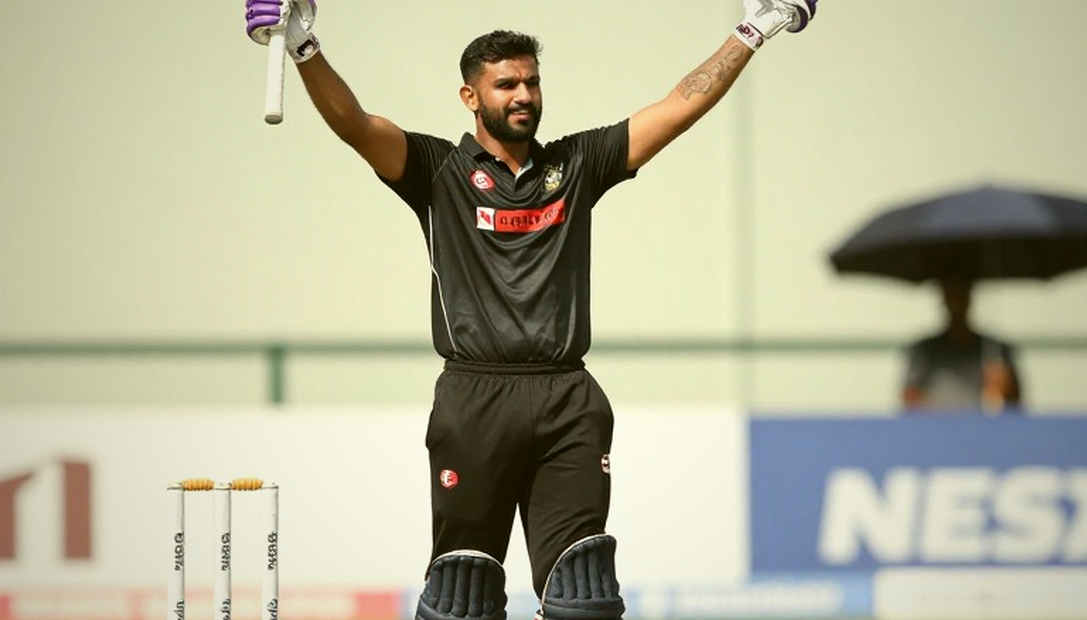
Lahore. Pakistan beat Sri Lanka by three wickets in the deciding match of the tri-nation ODI series. At the Gaddafi Stadium, Sri Lanka posted 325 for 8 in their 50 overs, and Pakistan chased it down at 331 for 7 in 48.3 overs — winning with nine balls to spare and three wickets in hand. The match had two faces: on one side the century of veteran opener Fakhar Zaman, which held the innings together; on the other the 61 off 31 from young all-rounder Arafat Minhas, which swung the contest in the closing phase. The trophy went to Pakistan, but the story inside the scoreline matters as much as the flat result it produced.
The arithmetic of the chase: 6.52 required, 6.82 achieved
Chasing 326 in 50 overs required Pakistan to score at 6.52 an over. At the finish their actual rate was 6.82 — meaning that by the end they had moved clear of the requirement. Add three wickets still standing at 48.3 overs, and it is clear Pakistan were never in a last-over panic. In the final three overs they needed less than a run a ball — the sort of cushion every batting side wants.
But there is a second reading of the same numbers. When you look at the whole innings — seven wickets lost, and the report's own note that even Fakhar's century 'seemed insufficient' — it is evident that the middle of the Pakistan innings wobbled. This was not a linear chase; it had a fall and a recovery. The 'three wickets' line is the final frame of the film, not the film itself.
Fakhar Zaman: experience as anchor, dependency as burden
Fakhar's century is the most solid fact of this match. When an opener scores a hundred in a 326 chase, it works on two levels: he refuses to let the innings collapse, and he removes the mental weight of the target from the rest of the batting order. The left-hander's defining quality has always been his ability to balance a fast start with a long innings.

But professional caution is warranted here. The available report does not state how many balls Fakhar took for his century. This is not a trivial statistic — it determines the strategic character of the innings. A hundred off 95 balls and a hundred off 130 balls are entirely different propositions. The first drives the team forward; the second transfers pressure onto partners. The report's own signal that the team felt pressure despite the century points towards an anchor-style hundred rather than an accelerating one. That is an inference, not a confirmed fact.
What is certain is the structural dependency. When one batter's century carries the whole weight of a 326 chase, the direct implication is that the rest of the top and middle order did not contribute in proportion. That can be a subject for praise of the individual — but from a team-building standpoint it is a source of concern.
Where Fakhar sits in his career arc also matters. On the public record he was born in 2026, placing him now in his mid-thirties. Batters typically peak between 27 and 33. For an opener whose game is built on hand speed and reflex, this is the phase in which the body begins to respond a fraction slower. With the 2027 ODI World Cup cycle in view, this is a risk that team management has to build into its planning.
One technical point in his favour: being a left-handed opener is a genuine tactical asset. It neutralises the angle of right-arm pace and forces the opposing captain to reset fields. But that advantage only pays off when the partner at the other end holds his ground — and in this match that balance was clearly missing.
Arafat Minhas: thirty-one balls of upheaval
The second major story is Arafat Minhas. Sixty-one off 31 balls — a strike rate of 196.8. That number is a statement in itself. In a 326 chase, scoring at nearly two runs per ball in the final ten overs is the act that turns a match. The conclusion follows without dispute: without that innings, the target was not reachable.
This is where professional honesty is required. Thirty-one balls is an innings, not a career. The route from one explosive innings to sustained international success has historically been long and low-yield. Before declaring a young player a 'star', a sample of at least 15 to 20 ODI innings across varied conditions is needed.
The conditions matter too. Batting explosively on a flat Lahore pitch, in front of a home crowd, while chasing a target is one thing. The same 31 balls against a quality new-ball attack on a seaming, two-paced surface in Australia or England is an entirely different challenge. The comparison is not meant to diminish anyone — it is meant to keep the assessment grounded.
Third and perhaps most important: if Minhas is genuinely a dual-skill all-rounder — a lower-middle-order batter striking at 190-plus who can also bowl a full ten-over spin quota — then his value far exceeds 61 runs. Such a player frees an entire slot in World Cup selection because he carries two responsibilities at once. That, rather than the 61 itself, is the real significance of the innings. The report does not confirm his bowling role, so this remains at the level of a plausible inference.
Seven wickets: the number the victory concealed
The most important conclusion of this analysis is that the least-discussed statistic in the match is the seven-wicket fall. 331 were scored, the target was reached, three wickets remained — everything looks fine. But losing seven wickets in a successful chase means the innings broke in the middle.
The cluster of wickets behind Fakhar's dismissal is a reasonable inference, given that Minhas had to come in from the lower middle order and make 61 off 31. Had the top order been in a commanding position, no such rescue act would have been necessary. Minhas arriving when he did is itself proof of a middle-order failure.
This is exactly where the gap between the scoreline and the team's real condition shows. On a flat home pitch, middle-order fragility gets covered, because bowlers get no assistance and one or two batters can drag the score up. On an away tour, when the ball moves and the required rate climbs, the same fragility converts directly into defeat.
It should also be noted that the report does not say who scored what beyond Fakhar and Minhas. This is a significant information gap and should not be hidden. Seven wickets fell, but the individual contributions are unknown — so an exact assessment of the middle order is not possible from this material. What can be said is that the collective contribution was inadequate.
Sri Lanka: scoring 325 and still losing
It would be unfair to underrate Sri Lanka's batting. 325 for 8 in 50 overs is a strong total, particularly away from home. It shows the Sri Lankan batting was comfortable in Pakistani conditions and did not buckle under the weight of a big first-innings target.
But the cause of their defeat is equally clear: conceding 331 and failing to take the last three wickets inside 48.3 overs. That is a bowling failure — specifically at the death. When the opposition reaches the target with three wickets and nine balls in hand, it is evident that both the ability to squeeze in the middle overs and the ability to take wickets at the end were lacking.
This fits Sri Lanka's broader trajectory. Since 2026 their ODI side has been in rebuild, and pace-bowling depth has been their most persistent weakness. Losing after scoring 325 is the signature of that imbalance — batting ahead of their ranking, bowling behind it.
The Lahore pitch: a festival for batting
This match produced 656 runs across 98.3 overs — roughly 6.66 an over in aggregate. That single figure says a great deal. The Gaddafi Stadium surface has historically been flat, with true bounce and short square boundaries, a venue where 320-plus totals are routine.
The direct implication is that no firm conclusions about bowlers can be drawn from this match — neither Pakistan's nor Sri Lanka's. When both sides reach 325 and 331, the question is why neither bowling unit could control the middle overs. The answer is likely one of two: either the pitch was so flat that no plan worked, or neither side possesses a controlling spinner for the middle phase. The report names no bowler and provides no figures, so this question cannot be answered yet.
One further point must be added: there is no information about the toss, dew, or day-night status. Dew is a decisive factor in ODI cricket, especially in the subcontinent. Without knowing who won the toss and who chose to bat, the strategic interpretation remains incomplete. This report acknowledges that gap rather than concealing it.
The tri-series: what is the trophy actually worth?
Winning a tri-nation series is an achievement, but its value depends on the identity of the third team. The report does not name that third participant. This is a major gap, because if the third side was a lower-ranked team, the competitive quality of the title is limited. If it was a strong side, the picture changes.
Similarly, this was almost certainly the final and decisive match of the series — inferable because the series victory was declared immediately after a completed chase. But that is an inference, not established fact.
Either way, one thing is clear: this win does not establish Pakistan as a dominant ODI force. A three-wicket home victory, on a flat pitch, against a mid-tier Sri Lankan side, is a competitive but narrow outcome roughly in line with expectations. To treat it as more than that — or as proof that the team is now settled — would be an overstatement.
The road ahead: three questions that need answers
The first question is at the top of the order. The team's ODI performance is disproportionately tied to one batter who is in the latter part of his career. If Fakhar's form dips or he is injured, the spine of the innings goes with him. A specialist opener succession plan is needed before the 2027 World Cup cycle, and it has to start now, because transitions take time.
The second question is the middle order. Losing seven wickets in a successful chase is a warning. A batter is needed at numbers four to seven who can protect wickets and rotate strike. Minhas's innings concealed the gap; it did not close it.
The third question is the bowling. Conceding 325 at home, when bowling has historically been Pakistan's strength, is a concern. Either the pitch is to blame or the attack lacks a controlling spinner. Away tours will expose the second cause, not the first.
The Minhas case: promise versus proof
The biggest risk in this analysis is not whether Pakistan won or lost — it is treating a 31-ball innings as a 'solved problem'. A strike rate of 196.8 is impressive, but it is one innings.
South Asian cricket media has an established habit: an explosive innings is followed immediately by the coronation of a young player as a 'new star'. Phrases like 'stormy innings' and 'dispelled all doubts with a single blow' belong to that tradition. Such language excites the reader; it does not measure the player.
The objective assessment is this: Minhas performed excellently under high pressure, and that is established. But his consistency, his technique in different conditions, and his bowling ability all remain untested. Only after 15 to 20 innings will it be possible to say whether this is a permanent solution or a beautiful coincidence.
Conclusion
Pakistan won the tri-nation series, and this is a continuation of their consistent home record. Fakhar Zaman's century demonstrated the value of experience, and Arafat Minhas's 31-ball innings showed the promise of young talent. Both are true and both should be acknowledged.
But a professional analysis must also look behind the scoreboard. Seven wickets lost, a middle order that broke, 325 conceded, and all of it on a flat home pitch — these are the limits of this victory. The match shows that Pakistan have the capacity to win; it does not show that their team is fully ready.
The real test will come not in Lahore but away — where the ball will move, the pitch will be two-paced, and the scoreboard will be far less generous.